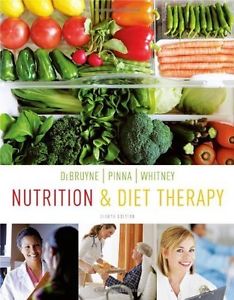
Test Bank For Nutrition And Diet Therapy 8th Ed By Whitney
$75.00Original price was: $75.00.$35.00Current price is: $35.00.
Test Bank For Nutrition And Diet Therapy 8th Ed By Whitney is one of the most comprehensive and well-rounded nutrition textbooks on the market. It provides students with a solid foundation in the basics of nutrition, including the latest research on the role of nutrition in health and disease.The book also features a wealth of practical information on how to implement nutritional therapy in clinical practice. In addition, the Test Bank for Nutrition and Diet Therapy 8th Ed By Whitney offers an invaluable resource for instructors, helping them to develop and assess student learning. Overall, this textbook is an essential tool for anyone interested in pursuing a career in nutrition or dietetics.Digital item No Waiting Time Instant Download
People are constantly busy nowadays and that’s why it’s important to resource oneself properly for study. We recommend the Test Bank for Nutrition and Diet Therapy 8th Edition by Whitney. This test bank was created to enable students to pass their nutrition courses with questions and answers that encompass all major concepts. It’s also an effective tool for those studying in general or getting ready for an exam.
Why Choose Our Test Bank?
All students should benefit from our test bank which has been prepared specifically with the student’s interests in mind. Such a general aspect draws a wide range of questions that are reflective of an actual examination. With this test bank at your disposal, you’re able to:
Enhance Understanding: Go beyond surface understanding of intricate issues with the penetration provided by thorough explanation.
Improve Grades: Work on questions that are very similar to the ones that will appear in an examination of the course.
Save Time: Ensure that the most critical concept in the area of study is the main focus of effort.
Key Topics Covered
Several important themes are ascertained in the Test Bank for Nutrition and Diet Therapy 8th Edition by Whitney which include:
Macronutrients and Micronutrients: Explain the functions of carbohydrates, proteins, fats, vitamins, and minerals in the body system.
Dietary Guidelines: Discuss the current dietary guidelines and their position in regard to the specific population.
Metabolism and Digestion: Understand the body in its quest to derive nutrition through food and its energy conversion.
Nutrition Across the Lifespan: Identify the changes in dietary requirements from infancy to old age.
Chronic Diseases and Nutrition: Investigate how one’s diet influences diseases: diabetes, heart diseases, and more.
How to Use the Test Bank
It is straightforward and efficient to make use of the test bank. First, remember the questions which pertain to the topics under study. Without looking at the link of the solutions, resolve the questions to check if you comprehend the concepts. After this, try to compare what you have written in your answers to the explanations provided. This strategy is effective in learning as well as boosting one’s self-esteem.
Benefits of Using a Test Bank
Time-efficient Focused Practice: Direct your energy to the segments that require a larger percentage of your effort.
Time-Free Study: Get to learn when you feel like it, regardless of the time and location.
Builds Confidence: Get used to the topic and the kind of questions that you are likely to face in the exam.
Summary
Buying the Test Bank for Nutrition and Diet Therapy 8th Edition Whitney is worth every penny for students who wish to perform their best in their nutrition class. It is quite useful for effective studying as well as exam preparation owing to its breadth of coverage and its practical questions. You should take this opportunity to further your studies and be able to meet your education objectives.
Test Bank For Nutrition And Diet Therapy 8th Ed By Whitney
Chapter 5 – Digestion and Absorption
Answer, K/A, page(s) K = knowledge question; A = application question
True/False
T K 107 1. A nutrient or other substance must pass through the cells of the digestive tract wall before it enters the body.
F K 107 2. Digestion is completed in the large intestine.
F K 110-111 3. Segmentation propels or pushes food through the GI tract while peristalsis mixes the food, with a more gradual pushing motion.
T K 111 4. The mouth initiates the liquefying process to reduce the food to a coarse mash suitable for swallowing.
F K 111 5. Of all the organs in the GI tract, the small intestine has the thickest walls and strongest muscles.
T K 113 6. Saliva protects tooth surfaces and the linings of the mouth, esophagus, and stomach from attack by molecules that might be harmful.
F K 113-114 7. Pepsin cannot function in the strong acid of the stomach.
T K 115 8. Drinking plenty of water in conjunction with eating foods high in fiber supplies fluid for the fiber to take up, thus relieving constipation.
F K 117 9. Some partially digested nutrients can be caught in the microvilli, but they cannot be further digested.
F K 117 10. People should not eat certain food combinations at the same meal because the digestive system cannot handle more than one task at a time.
Multiple Choice
c K 107 1. Another name for the digestive tract is the:
a. urinary tract.
b. exocrine system.
c. gastrointestinal system.
d. muscular system.
d K 107 2. The digestive tract begins at the ____ and ends at the ____.
a. stomach; large intestine
b. pharynx; rectum
c. lower esophageal sphincter; rectum
d. mouth; anus
b K 107 3. A bolus is a(n):
a. sphincter muscle separating the stomach from the small intestine.
b. portion of food swallowed at one time.
c. enzyme that hydrolyzes starch.
d. portion of partially digested food expelled by the stomach into the duodenum.
b K 107 4. The _____ is formed in the mouth.
a. bile
b. bolus
c. chyme
d. villus
d K 107 5. The _____ prevents food from entering the lungs.
a. lower esophageal sphincter
b. pharynx
c. ileocecal valve
d. epiglottis
d K 107 6. The stomach empties into the:
a. ileum.
b. cecum.
c. jejunum.
d. duodenum.
a K 107 7. Chyme is:
a. a semiliquid mass of partially digested food.
b. a portion of food swallowed at one time.
c. an enzyme in the stomach needed for the digestion of protein.
d. an esophageal secretion.
a K 107 8. Two organs that secrete digestive juices into the small intestine are the _____ and _____.
a. gallbladder; pancreas
b. pancreas; liver
c. gallbladder; liver
d. duodenum; pancreas
b K 107 9. The movement of chyme from the stomach into the small intestine is regulated by the:
a. pancreas.
b. pyloric sphincter.
c. ileocecal valve.
d. duodenum.
c K 108 10. Immediately before passing into the large intestine, the food mass must pass through the:
a. pyloric sphincter.
b. lower esophageal sphincter.
c. ileocecal valve.
d. bolus.
d K 110-111 11. “Peristalsis” is a term that refers to the:
a. circulation of blood in the blood vessels.
b. absorption of food in the intestines.
c. mixing and moving of food through the lymphatic system.
d. action of the involuntary muscles of the digestive tract.
a K 110-111 12. Involuntary muscle contractions move food through the intestinal tract. The movement that forces the contents back a few inches before pushing it forward again is called:
a. segmentation.
b. rotation.
c. peristalsis.
d. liquefaction.
a K 113 13. Enzymes:
a. facilitate chemical reactions.
b. draw water into the small intestine.
c. are present in all parts of the GI tract.
d. encourage bacterial growth.
c K 113 14. Which specific enzyme breaks down starch in the mouth?
a. carbohydrase
b. lipase
c. salivary amylase
d. gastric protease
c K 113 15. Saliva contains an enzyme that digests: